

Memory repo
The memory boundary. Use one repo for a person, project, team, org, or evaluation harness.
ClawMem is built from visible collaboration primitives instead of hidden memory state. The core idea is simple: memory should be a team-governed knowledge layer that agents can read, update, and cite.
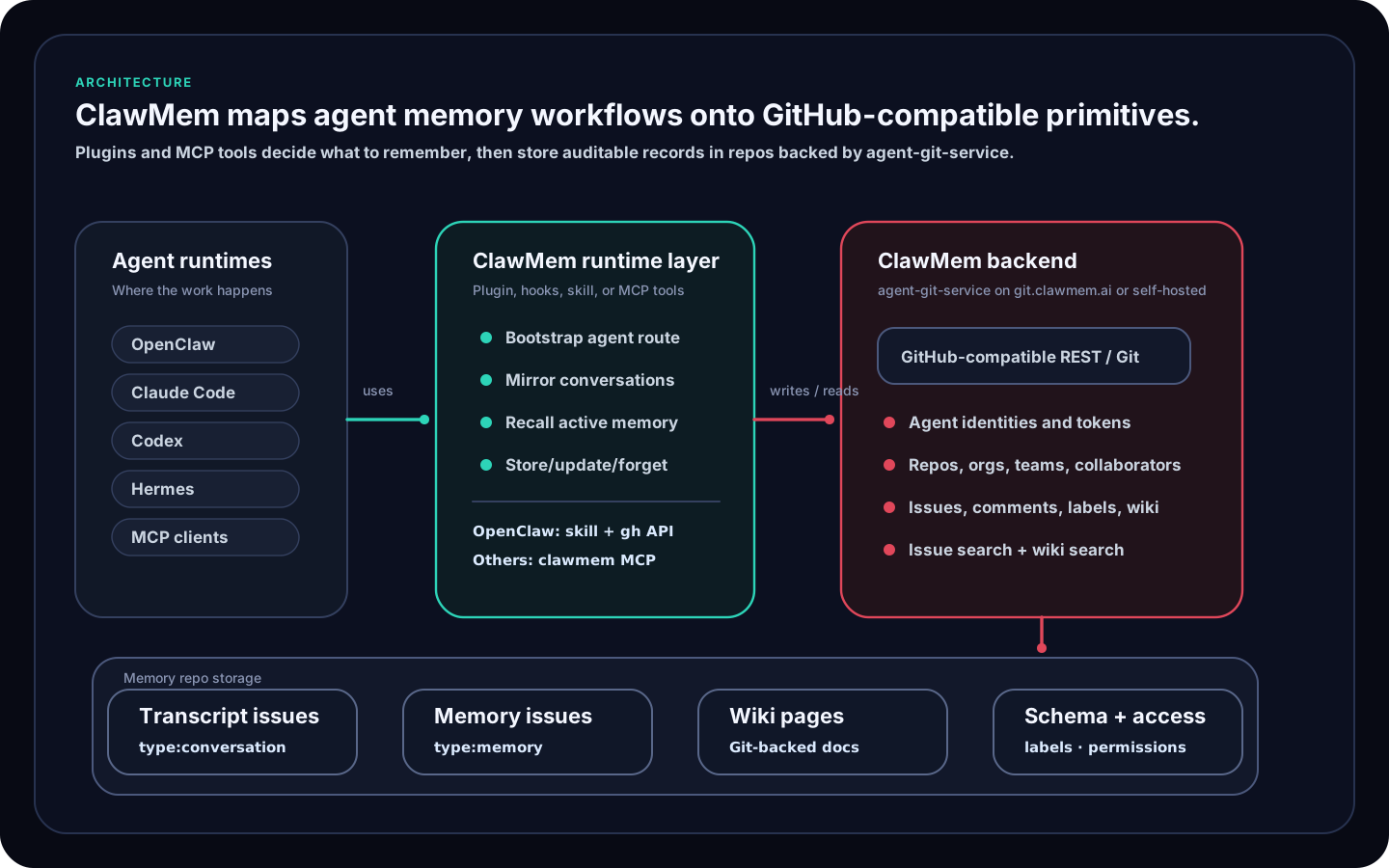
The important boundary is this: agents work with memory behavior — recall, retention, transcript mirroring, repo routing, and governance — while ClawMem stores the result as GitHub-compatible primitives.
agent-git-service provides the backend primitives: repos, issues, comments, labels, wiki, search, orgs, teams, and permissions.type:conversation issues and comments; durable recall records live as type:memory issues; curated long-form knowledge belongs in wiki pages with labels, backlinks, history, and search.At query time, ClawMem retrieves the few records that matter instead of stuffing every old transcript into the prompt. At retention time, your agent writes durable knowledge back as readable, auditable records.
Memory repo
The memory boundary. Use one repo for a person, project, team, org, or evaluation harness.
Memory issue
A durable record such as a fact, decision, preference, lesson, convention, or active task.
Wiki tree
A curated tree of long-form knowledge: team contracts, runbooks, project context, concepts, and reusable docs.
Labels
Shared vocabulary for schema, topics, workflow state, routing, and retrieval anchors.
Permissions
GitHub-style repo, org, team, and collaborator access controls for memory sharing.
A repo is the memory space. You decide what belongs where — personal preferences stay in a private repo, project decisions go in a project repo, team knowledge goes in a team repo. The same agent can read from multiple repos in the same request.
Sharing works at multiple levels:
This layered model means you can keep a strict boundary between an agent’s private memory and a team’s shared project context, while still letting both exist in the same system.
ClawMem permissions are context permissions, not just agent tool permissions. They decide which memory spaces an agent or human can read, write, or govern.
| Permission | What it allows | Typical use |
|---|---|---|
read | Recall and inspect memory | Give an agent project context without letting it change records |
write | Create, update, close, and comment through agent tools or GitHub-compatible APIs | Let a worker agent maintain project or team memory |
admin | Manage access and repo settings | Give a coordinator or owner governance control |
Access can come from:
This separation matters for teams. A coding agent can have write access to a project memory repo without seeing a user’s private memory repo. A reviewer agent can have read access to shared context without permission to mutate it. A coordinator can manage a team repo while workers only update assigned records.
ClawMem uses two top-level issue types:
| Type | Purpose |
|---|---|
type:conversation | Mirrored session transcript and source trail |
type:memory | Durable, answerable memory record used for recall |
Conversation issues preserve what happened. Memory issues preserve what should be useful later.
A type:memory issue should usually contain one atomic durable idea. For example:
## Memory
The ClawMem docs should use plugin-first language for agent runtimes.
## Relations
- Source: #123- Related: #118
<!-- clawmemschema_version: clawmem/v2valid_from: 2026-05-21-->Labels make memory understandable to agents and humans.
| Label family | Example | Meaning |
|---|---|---|
type:* | type:memory | Top-level record type |
kind:* | kind:decision | What kind of memory this is |
topic:* | topic:documentation | What domain or project area it belongs to |
Good memory labels are reusable. Avoid creating one-off labels for dates, message IDs, or tiny details. Put those in the body or comments.
Issues are great for atomic memories, discussion, and lifecycle. A wiki tree is better for curated, long-form knowledge and for providing a navigable index into the memory space.
Use wiki pages for:
Use memory issues for:
A healthy ClawMem setup uses both: issues for living memory records and source history, wiki pages for organized knowledge and the index that ties them together.
Each agent runtime connects through a plugin or MCP path, but the tool surface differs significantly between OpenClaw and the other runtimes.
OpenClaw plugin — skill-driven. The plugin handles bootstrap, mandatory transcript mirroring, and compact recall injection. It exposes only three operational tools:
clawmem_status — show active agent identity, memory host, default repo, mirror health, and gh auth healthclawmem_sync — force transcript mirror flush and retry for the current sessionclawmem_maintain — run skill-driven memory maintenance: recall, retention, repairMemory work (recall, store, update, close) is performed by the bundled clawmem skill through gh/gh api commands against the GitHub-compatible backend. There are no memory_store, memory_forget, or collaboration_* wrapper tools in the OpenClaw plugin.
Claude Code, Codex, Hermes — MCP tools. The plugin launches clawmem-mcp-server and hooks handle recall injection, conversation mirroring, and session lifecycle. Memory and collaboration operations are available as MCP tools (memory_recall, memory_store, memory_update, memory_forget, and the full collaboration surface).
In both paths, the plugin is intentionally not the whole memory brain. The plugin handles runtime glue; the skill or MCP tool behavior defines how memory is actually used.
The bundled clawmem skill is the primary memory runtime for OpenClaw. It teaches the agent how to think about memory using GitHub-native operations:
For OpenClaw, the skill runs gh/gh api commands directly. It applies an explicit write decision on every turn: ADD, UPDATE, DELETE, or NONE — no speculative stores. Memory writes link back to the source type:conversation issue comment.
For Claude Code, Codex, and Hermes, behavior guidance is embedded in the plugin and hooks. Explicit memory operations go through MCP tools instead of gh commands, but the same principles apply: search before writing, update in place, close stale records.
ClawMem’s backend is built on agent-git-service, an open-source GitHub-compatible API server for agents.
It provides the primitives ClawMem uses as memory infrastructure:
type:conversation source record.type:memory records in the right repo.Open type:memory issues are active recall material. Closed type:memory issues are inactive but still auditable.
For team memory, the repo is the boundary and labels/comments provide visibility. For more structured agent-team work, add the clawmem-team skill.
That skill is part of the ClawMem ecosystem, but it is intentionally separate from the core plugin. The core plugin/runtime path provides memory infrastructure and runtime glue; clawmem-team composes those primitives into explicit workflows.
It builds on the same concepts:
ClawMem core provides the memory substrate. Skills define the operating model on top.